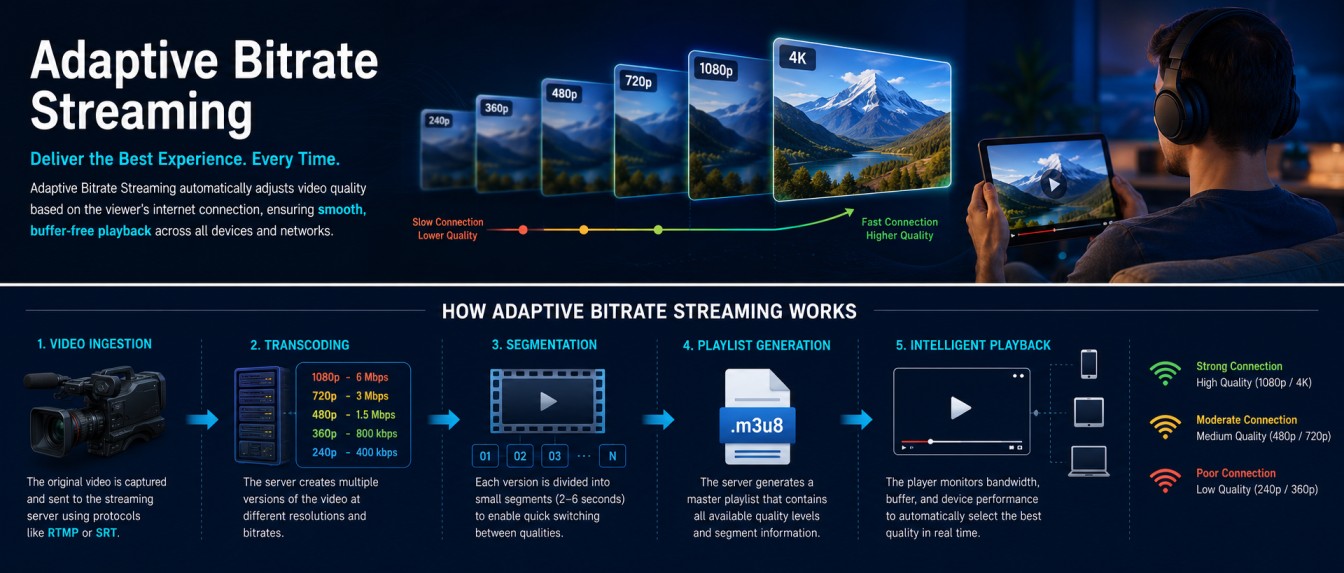
How Adaptive Bitrate Streaming Works: The Complete Guide to Buffer-Free Video Streaming (2026)

You’re watching a football game or your favorite show online. The video is playing smoothly, then your internet connection gets weak. Normally, the video would buffer every few seconds — but instead, the stream adjusts itself. It drops from 1080p to 720p or 480p and keeps playing without interruption.
A little while later, your connection improves, and the stream switches back to a higher resolution. This is Adaptive Bitrate Streaming (ABR) at work — the technology that keeps video playing smoothly no matter how your connection changes.
ABR does this by constantly monitoring your internet connection. If it’s weak, the stream lowers video quality; if it’s strong, quality increases. This way, you can keep watching without buffering. It’s used by nearly every major video platform, including YouTube, Netflix, Amazon Prime Video, Twitch, Facebook Live, and countless business streaming solutions.
ABR matters because it keeps the video playing instead of making you wait for it to buffer. Without it, platforms would struggle to deliver a consistent viewing experience to audiences with wildly different internet speeds.
Internet speeds vary from person to person — and can even change throughout the day for the same person. Streaming platforms need a way to deliver a good experience regardless of connection quality. ABR solves this by preparing multiple versions of the same video and automatically selecting the best one in real time.
In this guide, we’ll cover how Adaptive Bitrate Streaming works, why it’s essential for video platforms today, its benefits, common workflows, key challenges, and how platforms like Tarangix use ABR to deliver quality live video worldwide.
What Is Adaptive Bitrate Streaming?
Adaptive Bitrate Streaming is a method of delivering video that adjusts quality based on a viewer’s internet speed, device, and available bandwidth.
Instead of producing one version of a video, the server generates several — each tailored to a different connection speed and device type. For example:
- 240p — 400 kbps
- 360p — 800 kbps
- 480p — 1.2 Mbps
- 720p — 3 Mbps
- 1080p — 6 Mbps
- 4K — 15–25 Mbps
When you start watching, the player checks your internet speed and picks the best available quality. If your connection speeds up, the player upgrades to higher quality; if it slows down, the player switches to a lower one — usually before buffering even starts.
These quality changes happen smoothly, so you often won’t even notice them.
Why Adaptive Bitrate Streaming Matters
Internet connections are rarely stable. A viewer might start on home Wi-Fi, switch to mobile data while commuting, then reconnect to a different Wi-Fi network later. Each of these networks has its own bandwidth, latency, and packet loss characteristics.
Without ABR:
- Videos pause frequently
- Buffering becomes common
- Playback can fail entirely
- Viewers abandon the stream
Research consistently shows that buffering is one of the top reasons viewers stop watching online video — even a few seconds of interruption can significantly hurt retention.
ABR minimizes these interruptions by prioritizing uninterrupted playback over a fixed video quality.
How Adaptive Bitrate Streaming Works
The full ABR workflow happens in several stages.
Step 1: Video Ingestion
Everything starts with a single source video.
- For live streaming, the broadcaster sends one high-quality stream to the streaming server using a protocol like RTMP or SRT.
- For Video on Demand (VOD), a high-resolution master file is uploaded.
This original stream becomes the source for every bitrate variant.
Step 2: Transcoding
The streaming server processes the source video and creates multiple encoded versions, for example:
Original Input
   ↓
1080p @ 6 Mbps
   ↓
720p @ 3 Mbps
   ↓
480p @ 1.5 Mbps
   ↓
360p @ 800 kbps
   ↓
240p @ 400 kbps
Each version preserves the content but differs in resolution, bitrate, and file size. This process is called transcoding.
Step 3: Video Segmentation
Rather than sending one continuous video file, each encoded version is split into small segments — typically 2, 4, or 6 seconds long.
1080p/
  segment1.ts
  segment2.ts
  segment3.ts
  ...

720p/
  segment1.ts
  segment2.ts
  segment3.ts
  ...
Segmenting the video lets the player switch between quality levels almost instantly.
Step 4: Playlist Generation
The streaming server generates a master playlist listing all available video variants, including:
- Resolution
- Bitrate
- Codec information
- Segment URLs for each quality level
Protocols like HLS and MPEG-DASH rely on these playlists to tell the player which streams are available.
Step 5: Intelligent Playback
The video player continuously monitors:
- Internet speed
- Download rate
- Buffer size
- CPU performance
- Device capability
Based on these signals, it requests the appropriate segment for current conditions:
- Conditions improving: 240p → 480p → 720p → 1080p
- Conditions worsening: 1080p → 720p → 480p → 360p
The viewer keeps watching without interruption.
Factors Used When Selecting Video Quality
Modern ABR algorithms weigh several variables:
- Available bandwidth — the player’s most important measurement; higher bandwidth allows higher quality.
- Buffer health — if the playback buffer runs low, the player quickly drops to a lower bitrate to avoid stalling.
- Device resolution — a smartphone doesn’t need 4K, so the player may intentionally choose a lower resolution to save bandwidth.
- CPU performance — older devices may struggle to decode high-resolution video, so ABR accounts for hardware limits.
- Network stability — frequent speed fluctuations influence bitrate decisions, since stable playback is always prioritized over peak quality.
Benefits of Adaptive Bitrate Streaming
- Reduced buffering — the biggest advantage. Instead of waiting for high-quality video to load, viewers keep watching at the best available quality.
- Better viewer experience — users rarely notice bitrate changes, but they immediately notice buffering. ABR keeps playback smooth.
- Improved global reach — users in regions with weaker connections can still watch without major interruptions.
- Lower bandwidth waste — streaming 4K to a viewer on a 480p display wastes bandwidth; ABR delivers only the quality that’s actually needed.
- Higher viewer retention — smooth playback keeps viewers engaged longer, increasing watch time and reducing drop-off.
Common Streaming Protocols Supporting ABR
HTTP Live Streaming (HLS) — one of the most widely used adaptive streaming protocols, supported by iOS, Android, smart TVs, browsers, and OTT platforms.
MPEG-DASH — an open standard used across many modern streaming platforms, offering flexibility and broad compatibility.
CMAF — Common Media Application Format, which improves compatibility between HLS and DASH while enabling lower latency.
Adaptive Bitrate Streaming for Live Events
ABR is especially important during live broadcasts such as:
- Sports events
- Webinars and online education
- Gaming streams
- Corporate meetings
- News broadcasts
- Concerts
When thousands of viewers connect from different networks at once, ABR ensures each one gets the best possible experience for their specific connection.
Challenges of Adaptive Bitrate Streaming
ABR is powerful, but it does introduce complexity:
- Increased storage — each video exists in multiple resolutions, requiring more storage than a single encoded file.
- Higher processing costs — generating multiple bitrate variants requires significant transcoding resources.
- More complex infrastructure — streaming servers must encode multiple versions, generate playlists, store segments, keep all variants synchronized, and deliver content reliably.
- Longer encoding time — for VOD, processing multiple resolutions increases the time before content becomes available.
Best Practices for Adaptive Bitrate Streaming
- Encode at several different resolutions to cover a range of devices and connections.
- Use H.264 or H.265 codecs as appropriate.
- Keep segment lengths consistent.
- Monitor how users are actually experiencing playback.
- Adjust available bitrate options to match your audience.
- Use a content delivery network (CDN) to reduce latency.
- Regularly check server performance and transcoding health.
How Tarangix Uses Adaptive Bitrate Streaming
At Tarangix, our priority is making sure people can watch video without interruption — and Adaptive Bitrate Streaming is central to how we do that.
Our system works with RTMP, SRT, and HLS to get video from broadcasters to viewers reliably. Behind the scenes, our infrastructure dynamically adjusts video quality based on each viewer’s device and connection, so playback stays smooth no matter where they are or what kind of internet they have.
We run servers across multiple regions to deliver video quickly to viewers worldwide, and we continuously monitor performance to keep startup times short and playback uninterrupted. This lets creators and broadcasters using Tarangix reach large audiences with reliable, high-quality video — without needing to worry about the technical complexity behind the scenes.
As video technology continues to evolve, Adaptive Bitrate Streaming will remain a core part of delivering quality video across every kind of device and network — and it’s a technology Tarangix will keep building on.