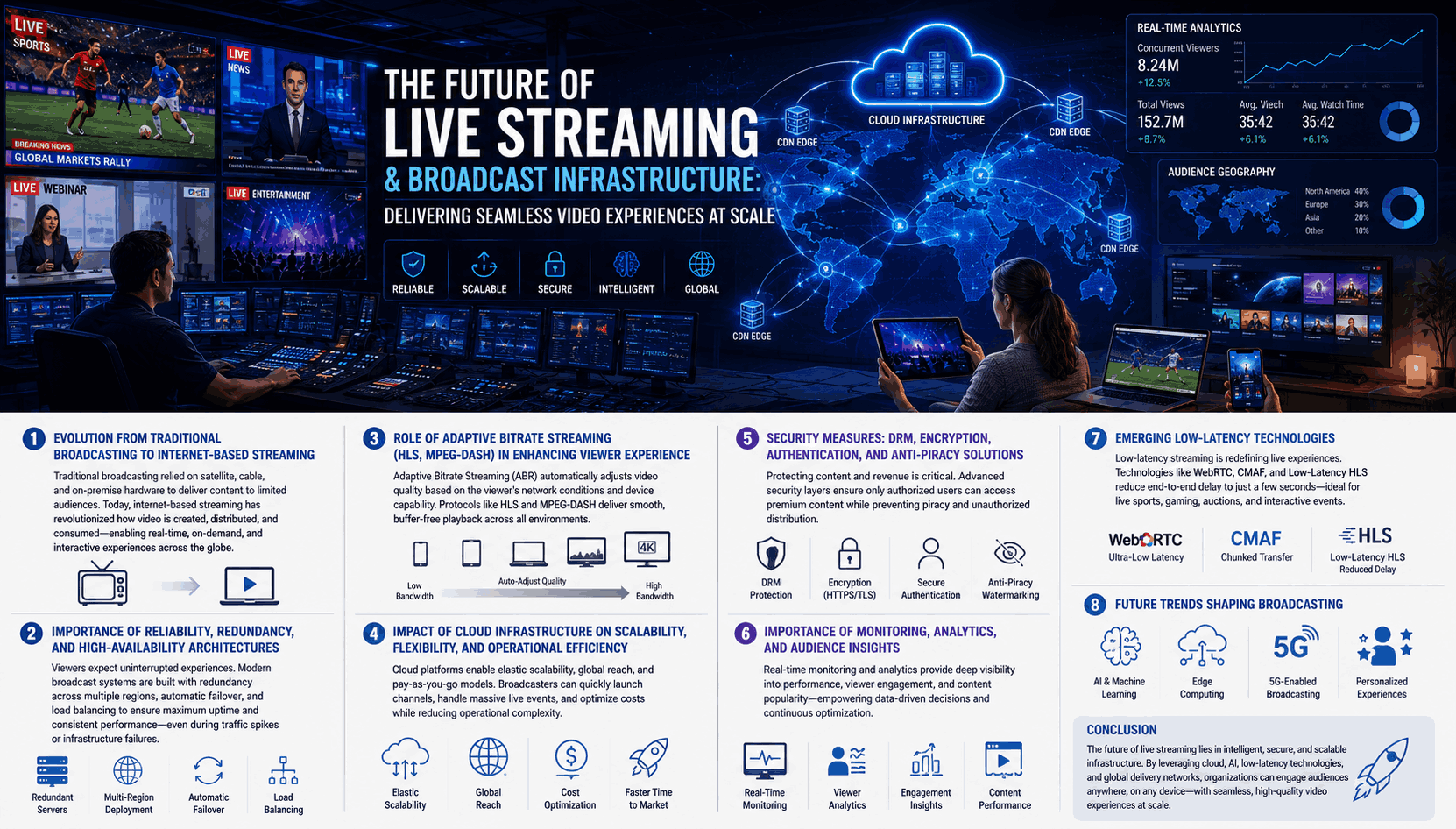
Live Streaming Infrastructure: 10 Powerful Trends Transforming Broadcasting

Content
Live streaming infrastructure has become the foundation of modern digital broadcasting. The digital media landscape has evolved dramatically over the past decade. What was once limited to traditional television broadcasting has transformed into a dynamic ecosystem powered by internet-based video delivery, cloud infrastructure, and real-time streaming technologies.
The digital media landscape has evolved dramatically over the past decade. What was once limited to traditional television broadcasting has transformed into a dynamic ecosystem powered by internet-based video delivery, cloud infrastructure, and real-time streaming technologies. Today, organizations across industries rely on live streaming and broadcast solutions to engage audiences, distribute content globally, and create immersive viewing experiences that transcend geographical boundaries.
From sports events and news coverage to corporate webinars, entertainment platforms, educational content, and government communications, modern streaming infrastructure has become the backbone of digital engagement. As audience expectations continue to rise, broadcasters and content providers must invest in scalable, reliable, and high-performance solutions that ensure uninterrupted content delivery regardless of audience size or location.
The Evolution of Modern Broadcasting
Traditional broadcasting relied heavily on satellite transmission, cable networks, and expensive hardware infrastructure. While these systems served audiences effectively for many years, they often lacked flexibility, scalability, and cost efficiency. The emergence of internet-based broadcasting introduced a new paradigm where content could be distributed globally through Content Delivery Networks (CDNs), cloud platforms, and adaptive bitrate streaming technologies.
Modern broadcasting solutions now enable organizations to deliver high-definition and ultra-high-definition content to millions of viewers simultaneously. Advanced encoding technologies optimize video quality while minimizing bandwidth consumption, ensuring smooth playback even in challenging network conditions.
The shift toward IP-based broadcasting has also enabled broadcasters to operate more efficiently. Cloud-native workflows, remote production capabilities, and automated content distribution systems have reduced operational complexity while increasing flexibility and scalability.
Why Reliability Matters in Live Streaming
Reliability remains one of the most critical factors in any streaming operation. Viewers expect instant access to content without buffering, interruptions, or quality degradation. Even a few seconds of downtime during a live event can result in audience dissatisfaction, revenue loss, and damage to brand reputation.
To address these challenges, streaming providers implement redundant infrastructure, failover mechanisms, multi-region deployments, and real-time monitoring systems. These technologies work together to ensure continuous service availability, even when unexpected technical issues occur.
High-availability architectures are particularly important for mission-critical broadcasts such as sports tournaments, financial market coverage, emergency communications, and large-scale virtual events where uninterrupted delivery is essential.
Adaptive Bitrate Streaming and Viewer Experience
One of the most significant advancements in streaming technology is Adaptive Bitrate Streaming (ABR). Rather than delivering a single video quality to all users, ABR dynamically adjusts video resolution and bitrate based on the viewer’s network conditions and device capabilities.
Protocols such as HLS (HTTP Live Streaming) and MPEG-DASH have become industry standards for adaptive delivery. These technologies allow viewers to enjoy a seamless experience whether they are watching on mobile devices, desktops, smart TVs, or connected streaming devices.
By automatically switching between quality levels, adaptive streaming minimizes buffering while maintaining the highest possible visual quality. This capability is essential in today’s multi-device environment where audience members access content using diverse network connections and hardware configurations.
The Role of Cloud Infrastructure in Broadcasting
Cloud computing has fundamentally changed how broadcasters build and manage their operations. Instead of investing heavily in on-premise infrastructure, organizations can leverage cloud services to scale resources on demand.
Cloud-based streaming platforms offer several advantages, including:
- Rapid deployment of streaming services
- Automatic scalability during traffic spikes
- Global content distribution capabilities
- Reduced infrastructure maintenance costs
- Enhanced disaster recovery and redundancy
- Simplified workflow management
As audience sizes fluctuate, cloud infrastructure allows broadcasters to allocate resources dynamically, ensuring optimal performance without unnecessary expenditure.
Security and Content Protection
As digital content becomes increasingly valuable, protecting media assets has become a top priority for broadcasters and content owners. Unauthorized redistribution, piracy, and cyber threats can significantly impact revenue and intellectual property rights.
Modern streaming platforms employ multiple layers of security, including:
- Secure token authentication
- Digital Rights Management (DRM)
- Encrypted video delivery
- Geo-restrictions and access control
- Watermarking technologies
- Real-time threat monitoring
These measures help ensure that content reaches authorized viewers while maintaining compliance with licensing and distribution agreements.
Real-Time Analytics and Monitoring
Successful streaming operations depend on visibility into system performance and audience behavior. Advanced analytics platforms provide valuable insights into viewer engagement, playback quality, network performance, and infrastructure health.
Broadcasters can monitor key metrics such as:
- Concurrent viewer counts
- Stream availability
- Bitrate performance
- Geographic audience distribution
- Device usage patterns
- Viewer retention rates
By analyzing this data, organizations can optimize content strategies, improve technical performance, and deliver more engaging viewer experiences.
The Growing Importance of Low-Latency Streaming
Audience expectations continue to evolve, particularly for interactive and real-time content. Sports betting, live auctions, gaming events, and interactive broadcasts require minimal delay between content creation and viewer consumption.
Emerging technologies such as Low-Latency HLS, WebRTC, and CMAF are helping broadcasters reduce streaming delays while maintaining scalability and reliability. These innovations enable near real-time interactions that enhance audience engagement and create new opportunities for content monetization.
Building a Scalable Streaming Future
The future of broadcasting will be defined by flexibility, scalability, and innovation. As technologies such as artificial intelligence, machine learning, edge computing, and 5G networks continue to mature, broadcasters will gain access to even more powerful tools for content creation and distribution.
Organizations that invest in modern streaming infrastructure today will be better positioned to meet future demands, adapt to changing viewer expectations, and deliver exceptional digital experiences across every platform and device.
Conclusion
Live streaming and digital broadcasting have become essential components of modern communication and entertainment. By leveraging advanced streaming protocols, cloud-native architectures, robust security measures, and intelligent monitoring systems, organizations can deliver reliable, high-quality content to audiences worldwide.
As the industry continues to evolve, businesses that embrace scalable and innovative broadcast technologies will remain competitive, enhance audience engagement, and unlock new opportunities for growth in the rapidly expanding digital media ecosystem.