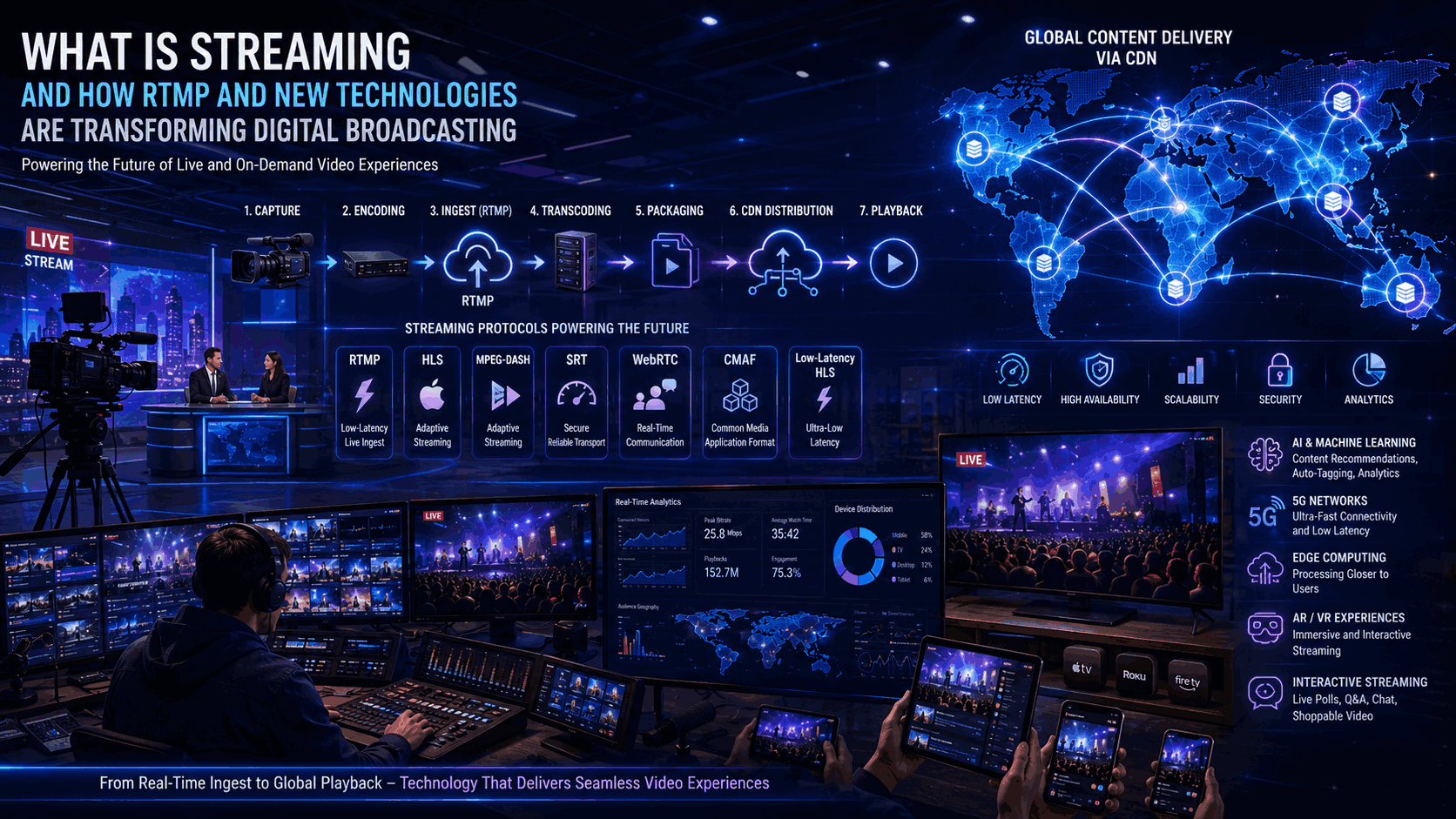
What is Streaming and How RTMP and New Technologies Are Transforming Digital Broadcasting

What is streaming? Streaming is the process of delivering audio and video content over the internet in real time without requiring users to download the complete file beforehand. The way people consume video content has changed dramatically over the last decade. In India alone, millions of users watch live cricket matches, webinars, gaming streams, OTT content, and educational videos every day.
Behind every seamless video experience lies a sophisticated ecosystem of streaming technologies, protocols, content delivery networks, and cloud infrastructure working together in real time.
But what exactly is streaming? How does live video travel from a creator’s camera to millions of viewers across the globe? And why has RTMP remained one of the most important technologies in broadcasting despite the emergence of newer protocols?
This article explores the fundamentals of streaming, the critical role of RTMP, and how modern technologies are shaping the future of digital broadcasting.
Understanding Streaming
Streaming is the process of transmitting audio or video content over the internet in a continuous flow, allowing users to consume media without downloading the entire file beforehand.
Traditionally, users had to download a complete video file before watching it. This approach was inefficient, especially for large media files. Streaming changed this model by delivering small chunks of data continuously while playback occurs simultaneously.
For example, when someone in Mumbai starts watching a live IPL match on a mobile device, the viewer does not download the entire match. Instead, the platform continuously sends small video segments over the internet while the viewer watches in real time.
Streaming can generally be categorized into two major types:
1. On-Demand Streaming
In on-demand streaming, prerecorded content is stored on servers and delivered whenever users request it.
Examples include:
- Netflix movies
- Amazon Prime Video series
- YouTube recorded videos
- Educational course videos
The viewer can pause, rewind, or resume playback at any time.
2. Live Streaming
Live streaming delivers content while it is being captured.
Examples include:
- Cricket broadcasts
- News channels
- Gaming streams
- Corporate webinars
- Religious ceremonies
- Political rallies
- Online classrooms
Live streaming presents significantly greater technical challenges because content must be encoded, transmitted, processed, and delivered to viewers with minimal delay.
How Streaming Actually Works
The streaming workflow consists of several stages.
Content Capture
Everything starts with a video source.
Examples include:
- DSLR cameras
- Mobile phones
- Professional broadcast cameras
- Screen capture software
- Gaming consoles
The raw video generated by these devices is extremely large and unsuitable for internet transmission.
Encoding
Encoding compresses raw video into digital formats optimized for network delivery.
Popular encoders include:
- OBS Studio
- vMix
- Wirecast
- FFmpeg
- Hardware encoders
Encoding reduces bandwidth requirements while maintaining acceptable quality.
For instance, a raw 1080p video feed may require several gigabits per second. After encoding, the same stream may only require 4-8 Mbps.
Ingest
The encoded video is then transmitted to a streaming server using an ingest protocol.
This is where RTMP traditionally plays a crucial role.
Transcoding
Modern streaming platforms often generate multiple versions of the same stream.
For example:
- 240p
- 480p
- 720p
- 1080p
- 4K
This process is known as transcoding.
Packaging
Video is then packaged into delivery formats such as:
- HLS
- MPEG-DASH
- CMAF
Distribution
Content is distributed globally using Content Delivery Networks (CDNs).
CDNs place copies of video content across multiple geographic regions, reducing latency and improving reliability.
Playback
Finally, viewers consume content through:
- Mobile applications
- Smart TVs
- Web browsers
- OTT applications
- Streaming devices
What is RTMP?
RTMP stands for Real-Time Messaging Protocol.
Adobe originally developed RTMP in the early 2000s to support Flash-based video streaming.
Although Adobe Flash has disappeared, RTMP continues to dominate live video ingest workflows.
Today, almost every streaming platform supports RTMP ingest.
Examples include:
- YouTube Live
- Facebook Live
- Twitch
- LinkedIn Live
- Custom OTT platforms
Why RTMP Became an Industry Standard
RTMP gained widespread adoption because it solved several major broadcasting challenges.
Low Latency
RTMP delivers video with relatively low delay compared to older methods.
This made it ideal for live broadcasting.
Stable Connections
RTMP uses persistent TCP connections that provide reliable delivery.
Broad Compatibility
Nearly all encoding software supports RTMP.
Popular tools such as OBS Studio and vMix use RTMP by default.
Simplicity
RTMP requires only a server URL and stream key.
This simplicity accelerated global adoption.
Typical RTMP Workflow
A standard RTMP workflow looks like this:
Camera → OBS Studio → RTMP Server → Transcoder → CDN → Viewer
For example:
A creator in Delhi streams using OBS.
OBS sends the encoded feed via RTMP to a streaming platform.
The platform transcodes the stream, distributes it through a CDN, and viewers across India watch on various devices.
Limitations of RTMP
Despite its strengths, RTMP has several limitations.
No Native Adaptive Streaming
RTMP does not inherently support adaptive bitrate streaming.
TCP Dependency
RTMP relies entirely on TCP.
Under poor network conditions, retransmissions can increase latency.
Security Concerns
Basic RTMP lacks modern security mechanisms.
Browser Incompatibility
Modern browsers do not natively support RTMP playback.
Consequently, RTMP is now primarily used for ingest rather than final delivery.
The Rise of New Streaming Technologies
As audience expectations evolved, new protocols emerged.
HLS (HTTP Live Streaming)
Developed by Apple, HLS has become the dominant playback protocol worldwide.
HLS works by dividing video into small HTTP-based segments.
Advantages include:
- Universal browser support
- Excellent scalability
- Adaptive bitrate streaming
- CDN compatibility
- Device independence
Today, most OTT platforms use HLS for video delivery.
MPEG-DASH
MPEG-DASH is an open international standard for adaptive streaming.
It offers capabilities similar to HLS while remaining codec agnostic.
Large broadcasters frequently deploy DASH alongside HLS.
SRT (Secure Reliable Transport)
SRT is one of the most important modern innovations in broadcasting.
Created by Haivision, SRT addresses limitations associated with traditional protocols.
Major benefits include:
Network Resilience
SRT recovers lost packets efficiently.
Security
SRT supports AES encryption.
Ultra-Low Latency
SRT significantly reduces transmission delays.
Internet Contribution
Broadcasters can replace expensive satellite links with internet-based contribution feeds.
Indian television networks increasingly use SRT for remote production workflows.
WebRTC
WebRTC enables real-time communication directly between browsers.
Typical use cases include:
- Video conferencing
- Interactive classrooms
- Live auctions
- Telemedicine
- Online interviews
WebRTC can achieve sub-second latency.
However, scaling WebRTC to millions of viewers remains challenging.
CMAF and Low-Latency HLS
Traditional HLS may introduce delays of 15-30 seconds.
New standards such as:
- Low-Latency HLS (LL-HLS)
- CMAF
reduce delays to just a few seconds.
These technologies are increasingly important for:
- Sports betting
- Interactive live events
- Real-time engagement
- Live commerce
Cloud Streaming Infrastructure
Modern broadcasters increasingly rely on cloud-native infrastructure.
Cloud platforms provide:
- Automatic scaling
- Global availability
- Reduced infrastructure costs
- Disaster recovery
- Multi-region deployment
Instead of purchasing expensive hardware, companies can provision resources on demand.
This flexibility is particularly important during major events such as IPL matches or national elections, where audience numbers can increase dramatically within minutes.
The Role of CDNs
A Content Delivery Network is essential for large-scale streaming.
Without CDNs, origin servers would quickly become overwhelmed.
CDNs distribute content from geographically distributed edge servers.
Benefits include:
- Lower latency
- Reduced buffering
- Increased reliability
- Higher scalability
- Improved viewer experience
For Indian audiences spread across metro cities and rural regions, CDN optimization significantly improves playback quality.
The Future of Streaming
Several emerging technologies are expected to reshape broadcasting.
Artificial Intelligence
AI-driven systems will automate:
- Transcoding optimization
- Content moderation
- Subtitle generation
- Audience analytics
5G Networks
5G promises:
- Higher bandwidth
- Lower latency
- Enhanced mobile experiences
Edge Computing
Processing video closer to users reduces delays and improves responsiveness.
Immersive Media
Future streaming may increasingly incorporate:
- Augmented Reality (AR)
- Virtual Reality (VR)
- 360-degree video
- Interactive experiences
Conclusion
Streaming has fundamentally transformed how people consume information, entertainment, and live events. While RTMP remains the backbone of live video ingest due to its simplicity and broad compatibility, modern broadcasting increasingly depends on technologies such as HLS, SRT, WebRTC, CMAF, and cloud-native infrastructure.
As India’s digital ecosystem continues to expand, organizations that adopt modern streaming technologies will be better positioned to deliver reliable, scalable, and engaging experiences to audiences across every device and network.
The future of streaming is not merely about delivering video. It is about delivering seamless, interactive, secure, and globally accessible digital experiences at scale.